
Welcome to the NAHA Collections Catalog!
Use our online catalog to explore our archival and manuscript collections. Some finding aids are currently offline, but we’re happy to help – just reach out to the NAHA archivist with any questions. Looking for digitized materials? Click here to browse thousands of items available online!
Browse Items (2907 total)
-
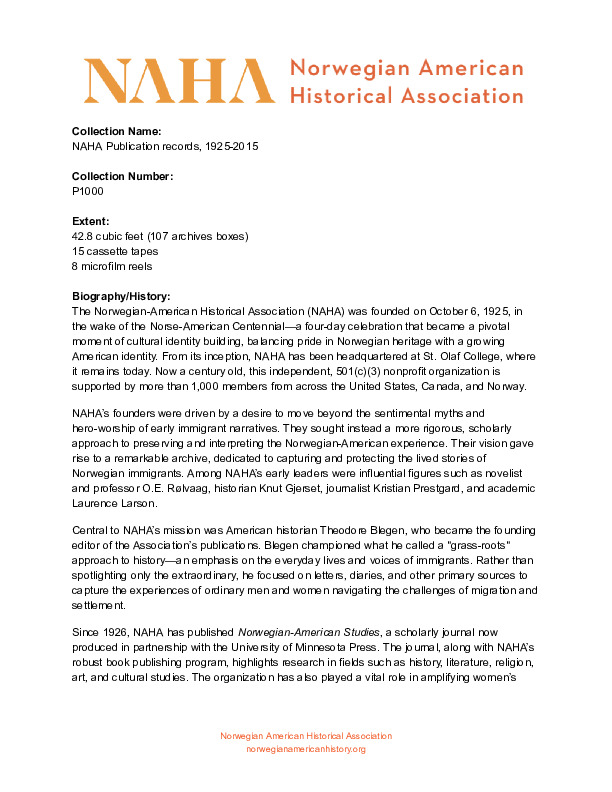
NAHA Publication records, 1925-2015
Biography/History:
The Norwegian-American Historical Association (NAHA) was founded on October 6, 1925, in the wake of the Norse-American Centennial—a four-day celebration that became a pivotal moment of cultural identity building, balancing pride in Norwegian heritage with a growing American identity. From its inception, NAHA has been headquartered at St. Olaf College, where it remains today. Now a century old, this independent, 501(c)(3) nonprofit organization is supported by more than 1,000 members from across the United States, Canada, and Norway.NAHA’s founders were driven by a desire to move beyond the sentimental myths and hero-worship of early immigrant narratives. They sought instead a more rigorous, scholarly approach to preserving and interpreting the Norwegian-American experience. Their vision gave rise to a remarkable archive, dedicated to capturing and protecting the lived stories of Norwegian immigrants. Among NAHA’s early leaders were influential figures such as novelist and professor O.E. Rølvaag, historian Knut Gjerset, journalist Kristian Prestgard, and academic Laurence Larson.
Central to NAHA’s mission was American historian Theodore Blegen, who became the founding editor of the Association’s publications. Blegen championed what he called a "grass-roots" approach to history—an emphasis on the everyday lives and voices of immigrants. Rather than spotlighting only the extraordinary, he focused on letters, diaries, and other primary sources to capture the experiences of ordinary men and women navigating the challenges of migration and settlement.
Since 1926, NAHA has published Norwegian-American Studies, a scholarly journal now produced in partnership with the University of Minnesota Press. The journal, along with NAHA’s robust book publishing program, highlights research in fields such as history, literature, religion, art, and cultural studies. The organization has also played a vital role in amplifying women’s ethnic history, publishing works by and about immigrant women like Aagot Raaen, Gro Svendsen, Elisabeth Koren, and Elise Waerenskjold.
Theodore C. Blegen, noted University of Minnesota historian, was appointed the first editor of NAHA. Later editors — Kenneth O. Bjork (1960–1980), Odd S. Lovoll (1980–2000), and Todd W. Nichol (2001–2017) — have built upon the Blegen tradition, opening new areas of research and expanding our range of critically acclaimed publications. In 2018, NAHA welcomed Anna M. Peterson of Luther College as the newest editor.
Scope and Content:
Records of the Norwegian-American Historical Association's publication program. Related collections in the NAHA Institutional Records include: Publication Records (P1000), Secretary Records (P1001), Financial Records (P1002), and Archivist Records (P1003).
Arrangement:
Series I: Correspondence and Institutional Records
Series II: Norwegian-American Studies
Series III: Manuscript Publishing and Correspondence
Series IV: Reviews of Norwegian-American Studies and Publications
Series V: Odd Lovoll ResearchFunding:
Funding to rehouse and describe the NAHA institutional records provided to the Norwegian American Historical Association through the Minnesota Arts and Cultural Heritage Fund, a component of the Minnesota Clean Water, Land and Legacy constitutional amendment, ratified by Minnesota voters in 2008.Processing Information:
Collection processed and described by Otelia Lighthill and Kristina Warner. -
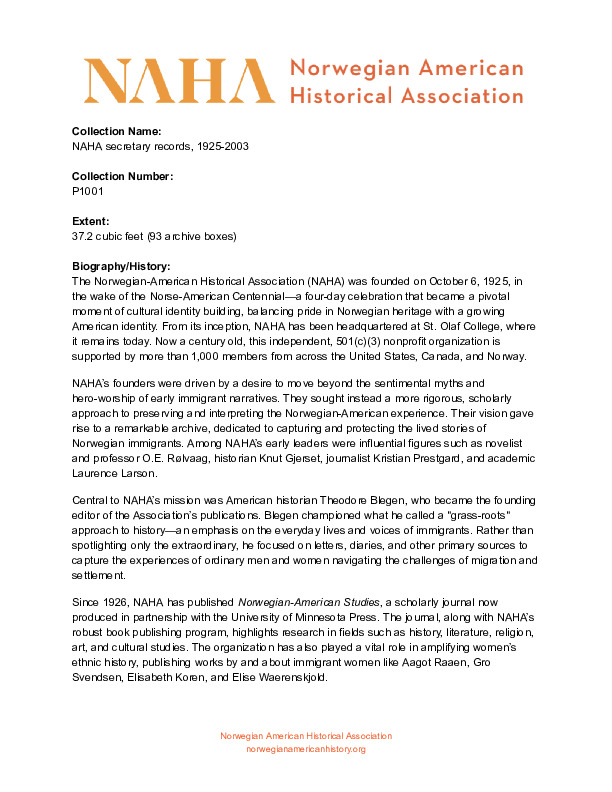
NAHA secretary records, 1925-2003
Biography/History:
The Norwegian-American Historical Association (NAHA) was founded on October 6, 1925, in the wake of the Norse-American Centennial—a four-day celebration that became a pivotal moment of cultural identity building, balancing pride in Norwegian heritage with a growing American identity. From its inception, NAHA has been headquartered at St. Olaf College, where it remains today. Now a century old, this independent, 501(c)(3) nonprofit organization is supported by more than 1,000 members from across the United States, Canada, and Norway.NAHA’s founders were driven by a desire to move beyond the sentimental myths and hero-worship of early immigrant narratives. They sought instead a more rigorous, scholarly approach to preserving and interpreting the Norwegian-American experience. Their vision gave rise to a remarkable archive, dedicated to capturing and protecting the lived stories of Norwegian immigrants. Among NAHA’s early leaders were influential figures such as novelist and professor O.E. Rølvaag, historian Knut Gjerset, journalist Kristian Prestgard, and academic Laurence Larson.
Central to NAHA’s mission was American historian Theodore Blegen, who became the founding editor of the Association’s publications. Blegen championed what he called a "grass-roots" approach to history—an emphasis on the everyday lives and voices of immigrants. Rather than spotlighting only the extraordinary, he focused on letters, diaries, and other primary sources to capture the experiences of ordinary men and women navigating the challenges of migration and settlement.
Since 1926, NAHA has published Norwegian-American Studies, a scholarly journal now produced in partnership with the University of Minnesota Press. The journal, along with NAHA’s robust book publishing program, highlights research in fields such as history, literature, religion, art, and cultural studies. The organization has also played a vital role in amplifying women’s ethnic history, publishing works by and about immigrant women like Aagot Raaen, Gro Svendsen, Elisabeth Koren, and Elise Waerenskjold.
Since NAHA’s founding, many individuals have served in the role of secretary. Among the most notable were O.E. Rølvaag (1925–1931), J. Jørgen Thompson (1931–1959), and Lloyd Hustvedt (1959–1999). In 1931, the responsibilities of the financial secretary were consolidated into the secretary position. Following Hustvedt’s long tenure, the title and structure of the role began to evolve. Others who carried out similar duties in the years that followed include Ruth Crane, Kim Holland, and Jackie Henry. Today, the position no longer exists in its earlier form, and NAHA is now led by an Executive Director.
Scope and Content:
Records of the secretary of the Norwegian-American Historical Association. Related collections in the NAHA Institutional Records include: Publication Records (P1000), Secretary Records (P1001), Financial Records (P1002), and Archivist Records (P1003).Arrangement:
Series I: Correspondence and General Records
Series II: General NAHA Records
Series III: Executive Board Records and Correspondence
Series IV: Archives Contribution and CorrespondenceFunding:
Funding to rehouse and describe the NAHA institutional records provided to the Norwegian American Historical Association through the Minnesota Arts and Cultural Heritage Fund, a component of the Minnesota Clean Water, Land and Legacy constitutional amendment, ratified by Minnesota voters in 2008.Processing Information:
Collection processed and described by Patrick Hagerty and Kristina Warner. -
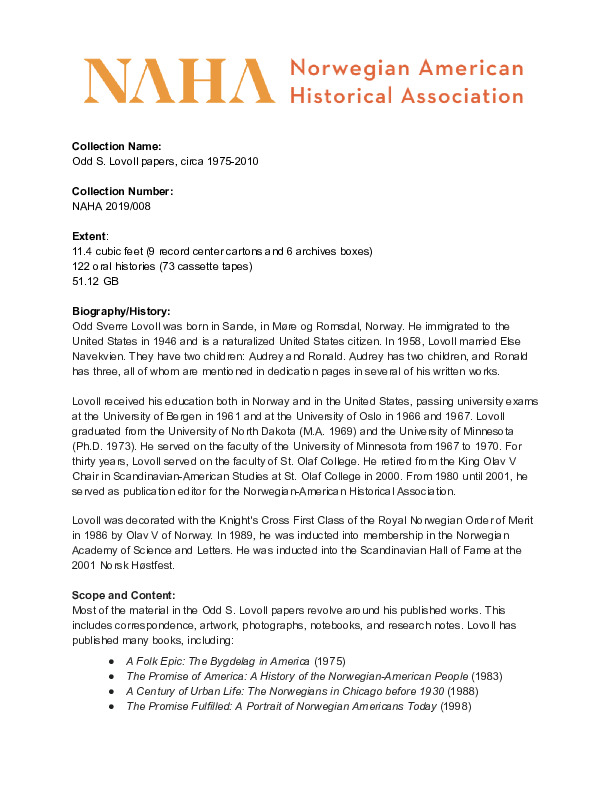
Odd S. Lovoll papers, circa 1975-2010
Biography/History:
Odd Sverre Lovoll was born in Sande, in Møre og Romsdal, Norway. He immigrated to the United States in 1946 and is a naturalized United States citizen. In 1958, Lovoll married Else Navekvien. They have two children: Audrey and Ronald. Audrey has two children, and Ronald has three, all of whom are mentioned in dedication pages in several of his written works.Lovoll received his education both in Norway and in the United States, passing university exams at the University of Bergen in 1961 and at the University of Oslo in 1966 and 1967. Lovoll graduated from the University of North Dakota (M.A. 1969) and the University of Minnesota (Ph.D. 1973). He served on the faculty of the University of Minnesota from 1967 to 1970. For thirty years, Lovoll served on the faculty of St. Olaf College. He retired from the King Olav V Chair in Scandinavian-American Studies at St. Olaf College in 2000. From 1980 until 2001, he served as publication editor for the Norwegian-American Historical Association.
Lovoll was decorated with the Knight's Cross First Class of the Royal Norwegian Order of Merit in 1986 by Olav V of Norway. In 1989, he was inducted into membership in the Norwegian Academy of Science and Letters. He was inducted into the Scandinavian Hall of Fame at the 2001 Norsk Høstfest.
Scope and Content:
Most of the material in the Odd S. Lovoll papers revolve around his published works. This includes correspondence, artwork, photographs, notebooks, and research notes. Lovoll has published many books, including:- A Folk Epic: The Bygdelag in America (1975)
- The Promise of America: A History of the Norwegian-American People (1983)
- A Century of Urban Life: The Norwegians in Chicago before 1930 (1988)
- The Promise Fulfilled: A Portrait of Norwegian Americans Today (1998)
- Norwegians on the Prairie: Ethnicity and the Development of the Country Town (2006)
- Norwegian newspapers in America: Connecting Norway and the new land (2010)
- Across the deep blue sea: The saga of early Norwegian immigrants (2015)
- Two Homelands: A Historian Considers His Life and Work (2018)
-
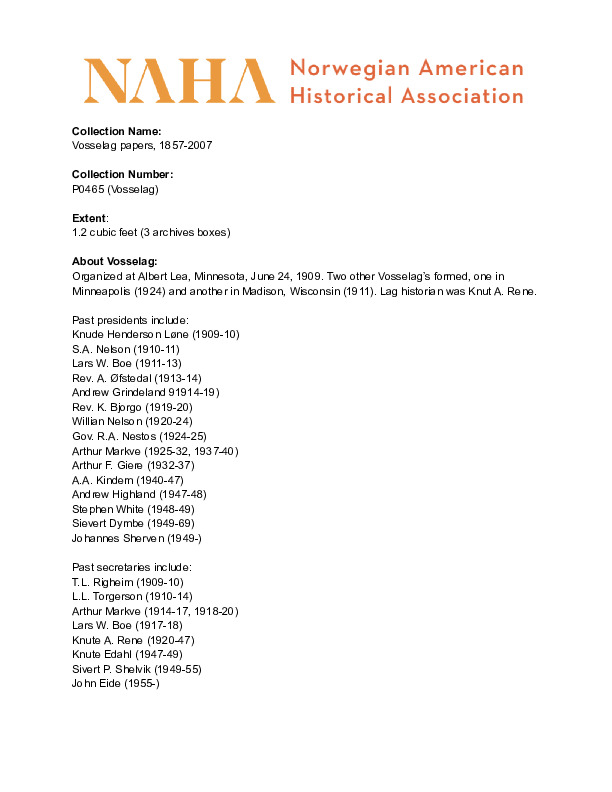
Vosselag papers, 1857-2007
About Vosselag:
Organized at Albert Lea, Minnesota, June 24, 1909. Two other Vosselag’s formed, one in Minneapolis (1924) and another in Madison, Wisconsin (1911). Lag historian was Knut A. Rene.Past presidents include:
Knude Henderson Løne (1909-10)
S.A. Nelson (1910-11)
Lars W. Boe (1911-13)
Rev. A. Øfstedal (1913-14)
Andrew Grindeland 91914-19)
Rev. K. Bjorgo (1919-20)
Willian Nelson (1920-24)
Gov. R.A. Nestos (1924-25)
Arthur Markve (1925-32, 1937-40)
Arthur F. Giere (1932-37)
A.A. Kindem (1940-47)
Andrew Highland (1947-48)
Stephen White (1948-49)
Sievert Dymbe (1949-69)
Johannes Sherven (1949-)Past secretaries include:
T.L. Righeim (1909-10)
Arthur Markve (1914-17, 1918-20)
Lars W. Boe (1917-18)
Knute A. Rene (1920-47)
Knute Edahl (1947-49)
Sivert P. Shelvik (1949-55)
John Eide (1955-)History of the Bygdelag:
Papers of "bygd" societies and their Common Council ("Bygdelagenes Fellesraad"), clippings, constitutions, correspondence, minutes and financial records, pamphlets, pictures, programs, and reports, dealing with conventions, officers, special projects, and the Norse-American Centennial of 1925. The bygdelag, organized around the turn of the century, are societies based on regional origins in Norway. They were active in the Eidsvoll Centennial in 1914 and the Norse-American Centennial in 1925. While activity dropped off after the beginning of World War II, a revival began in the 1980s as a result of renewal of ethnic interest, and with emphasis on family history. Odd S. Lovoll's "A Folk Epic; The Bygdelag in America" (NAHA, 1975), which includes a bibliography of lag publications.Papers of the various "bygdelag," "social organizations of (Americans) from the same homeland district, usually rural" which began in 1899 with the organization of the Valdres Samband. About fifty other lag with national-wide appeal were formed, as well as many others which were more local. They held annual "stevner" (meetings) and many published periodicals, yearbooks, or monographs which often contained extensive genealogical materials. A decline came after World War II, with a revival in the 1970s particularly through renewed emphasis on genealogical research.
A Council of Bygdelags (Bygdelagenes Faellesraad) coordinates activities of the groups. They were very active in the Eidsvoll centennial celebrations in 1914, and the Norse-American Centennial in 1925. Holdings for the various lag vary, but usually include clippings of newspaper articles about their meetings, correspondence, programs, and copies of their publications, duplicates of library holdings, in the periodical and book collections (monographs and annuals included in the latter). In some cases regional associations are included with the national groups, and in others separate groups which later merged are included under the merged name.
-
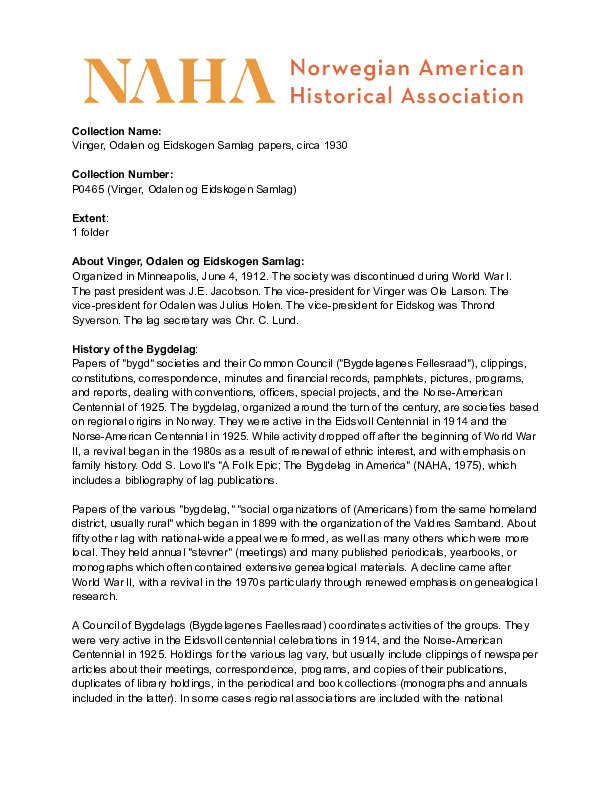
Vinger, Odalen og Eidskogen Samlag papers, circa 1930
About Vinger, Odalen og Eidskogen Samlag:
Organized in Minneapolis, June 4, 1912. The society was discontinued during World War I.The past president was J.E. Jacobson. The vice-president for Vinger was Ole Larson. The vice-president for Odalen was Julius Holen. The vice-president for Eidskog was Thrond Syverson. The lag secretary was Chr. C. Lund.
History of the Bygdelag:
Papers of "bygd" societies and their Common Council ("Bygdelagenes Fellesraad"), clippings, constitutions, correspondence, minutes and financial records, pamphlets, pictures, programs, and reports, dealing with conventions, officers, special projects, and the Norse-American Centennial of 1925. The bygdelag, organized around the turn of the century, are societies based on regional origins in Norway. They were active in the Eidsvoll Centennial in 1914 and the Norse-American Centennial in 1925. While activity dropped off after the beginning of World War II, a revival began in the 1980s as a result of renewal of ethnic interest, and with emphasis on family history. Odd S. Lovoll's "A Folk Epic; The Bygdelag in America" (NAHA, 1975), which includes a bibliography of lag publications.Papers of the various "bygdelag," "social organizations of (Americans) from the same homeland district, usually rural" which began in 1899 with the organization of the Valdres Samband. About fifty other lag with national-wide appeal were formed, as well as many others which were more local. They held annual "stevner" (meetings) and many published periodicals, yearbooks, or monographs which often contained extensive genealogical materials. A decline came after World War II, with a revival in the 1970s particularly through renewed emphasis on genealogical research.
A Council of Bygdelags (Bygdelagenes Faellesraad) coordinates activities of the groups. They were very active in the Eidsvoll centennial celebrations in 1914, and the Norse-American Centennial in 1925. Holdings for the various lag vary, but usually include clippings of newspaper articles about their meetings, correspondence, programs, and copies of their publications, duplicates of library holdings, in the periodical and book collections (monographs and annuals included in the latter). In some cases regional associations are included with the national groups, and in others separate groups which later merged are included under the merged name.
-
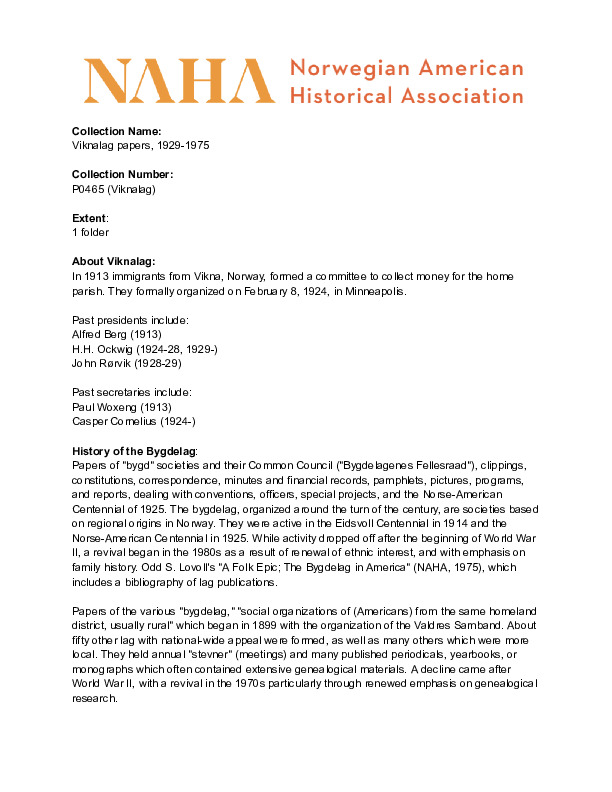
Viknalag papers, 1929-1975
About Viknalag:
In 1913 immigrants from Vikna, Norway, formed a committee to collect money for the home parish. They formally organized on February 8, 1924, in Minneapolis.Past presidents include:
Alfred Berg (1913)
H.H. Ockwig (1924-28, 1929-)
John Rørvik (1928-29)Past secretaries include:
Paul Woxeng (1913)
Casper Cornelius (1924-)History of the Bygdelag:
Papers of "bygd" societies and their Common Council ("Bygdelagenes Fellesraad"), clippings, constitutions, correspondence, minutes and financial records, pamphlets, pictures, programs, and reports, dealing with conventions, officers, special projects, and the Norse-American Centennial of 1925. The bygdelag, organized around the turn of the century, are societies based on regional origins in Norway. They were active in the Eidsvoll Centennial in 1914 and the Norse-American Centennial in 1925. While activity dropped off after the beginning of World War II, a revival began in the 1980s as a result of renewal of ethnic interest, and with emphasis on family history. Odd S. Lovoll's "A Folk Epic; The Bygdelag in America" (NAHA, 1975), which includes a bibliography of lag publications.Papers of the various "bygdelag," "social organizations of (Americans) from the same homeland district, usually rural" which began in 1899 with the organization of the Valdres Samband. About fifty other lag with national-wide appeal were formed, as well as many others which were more local. They held annual "stevner" (meetings) and many published periodicals, yearbooks, or monographs which often contained extensive genealogical materials. A decline came after World War II, with a revival in the 1970s particularly through renewed emphasis on genealogical research.
A Council of Bygdelags (Bygdelagenes Faellesraad) coordinates activities of the groups. They were very active in the Eidsvoll centennial celebrations in 1914, and the Norse-American Centennial in 1925. Holdings for the various lag vary, but usually include clippings of newspaper articles about their meetings, correspondence, programs, and copies of their publications, duplicates of library holdings, in the periodical and book collections (monographs and annuals included in the latter). In some cases regional associations are included with the national groups, and in others separate groups which later merged are included under the merged name.
Oversized lag photographs and panoramas are located within the Photograph Collection (P0655). -
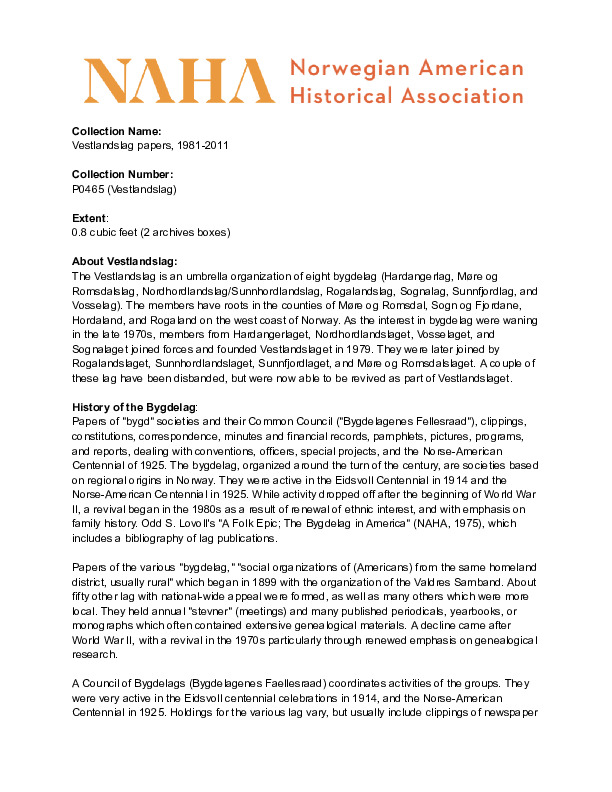
Vestlandslag papers, 1981-2011
About Vestlandslag:
The Vestlandslag is an umbrella organization of eight bygdelag (Hardangerlag, Møre og Romsdalslag, Nordhordlandslag/Sunnhordlandslag, Rogalandslag, Sognalag, Sunnfjordlag, and Vosselag). The members have roots in the counties of Møre og Romsdal, Sogn og Fjordane, Hordaland, and Rogaland on the west coast of Norway. As the interest in bygdelag were waning in the late 1970s, members from Hardangerlaget, Nordhordlandslaget, Vosselaget, and Sognalaget joined forces and founded Vestlandslaget in 1979. They were later joined by Rogalandslaget, Sunnhordlandslaget, Sunnfjordlaget, and Møre og Romsdalslaget. A couple of these lag have been disbanded, but were now able to be revived as part of Vestlandslaget.
History of the Bygdelag:
Papers of "bygd" societies and their Common Council ("Bygdelagenes Fellesraad"), clippings, constitutions, correspondence, minutes and financial records, pamphlets, pictures, programs, and reports, dealing with conventions, officers, special projects, and the Norse-American Centennial of 1925. The bygdelag, organized around the turn of the century, are societies based on regional origins in Norway. They were active in the Eidsvoll Centennial in 1914 and the Norse-American Centennial in 1925. While activity dropped off after the beginning of World War II, a revival began in the 1980s as a result of renewal of ethnic interest, and with emphasis on family history. Odd S. Lovoll's "A Folk Epic; The Bygdelag in America" (NAHA, 1975), which includes a bibliography of lag publications.Papers of the various "bygdelag," "social organizations of (Americans) from the same homeland district, usually rural" which began in 1899 with the organization of the Valdres Samband. About fifty other lag with national-wide appeal were formed, as well as many others which were more local. They held annual "stevner" (meetings) and many published periodicals, yearbooks, or monographs which often contained extensive genealogical materials. A decline came after World War II, with a revival in the 1970s particularly through renewed emphasis on genealogical research.
A Council of Bygdelags (Bygdelagenes Faellesraad) coordinates activities of the groups. They were very active in the Eidsvoll centennial celebrations in 1914, and the Norse-American Centennial in 1925. Holdings for the various lag vary, but usually include clippings of newspaper articles about their meetings, correspondence, programs, and copies of their publications, duplicates of library holdings, in the periodical and book collections (monographs and annuals included in the latter). In some cases regional associations are included with the national groups, and in others separate groups which later merged are included under the merged name.
-
Vestfoldlag papers, 1922-1955
About Vestfoldlag:
Organized in Minneapolis, December 27, 1925. The Twin Cities Vestfoldlaget, formed on May 20, 1927, eventually merged with the national Vestfoldlag.Past presidents include:
O.P.B. Jacobson (1926-27)
C.S.B. Hoel (1927-28)
M.A. Kalleberg (19287-)
E. Klaveness (-1950s)Past secretaries include:
M.A. Kalleberg (1925-28)
Carl A. Bredahl (1928-)
H.M. Jacobson (-1950s)History of the Bygdelag:
Papers of "bygd" societies and their Common Council ("Bygdelagenes Fellesraad"), clippings, constitutions, correspondence, minutes and financial records, pamphlets, pictures, programs, and reports, dealing with conventions, officers, special projects, and the Norse-American Centennial of 1925. The bygdelag, organized around the turn of the century, are societies based on regional origins in Norway. They were active in the Eidsvoll Centennial in 1914 and the Norse-American Centennial in 1925. While activity dropped off after the beginning of World War II, a revival began in the 1980s as a result of renewal of ethnic interest, and with emphasis on family history. Odd S. Lovoll's "A Folk Epic; The Bygdelag in America" (NAHA, 1975), which includes a bibliography of lag publications.Papers of the various "bygdelag," "social organizations of (Americans) from the same homeland district, usually rural" which began in 1899 with the organization of the Valdres Samband. About fifty other lag with national-wide appeal were formed, as well as many others which were more local. They held annual "stevner" (meetings) and many published periodicals, yearbooks, or monographs which often contained extensive genealogical materials. A decline came after World War II, with a revival in the 1970s particularly through renewed emphasis on genealogical research.
A Council of Bygdelags (Bygdelagenes Faellesraad) coordinates activities of the groups. They were very active in the Eidsvoll centennial celebrations in 1914, and the Norse-American Centennial in 1925. Holdings for the various lag vary, but usually include clippings of newspaper articles about their meetings, correspondence, programs, and copies of their publications, duplicates of library holdings, in the periodical and book collections (monographs and annuals included in the latter). In some cases regional associations are included with the national groups, and in others separate groups which later merged are included under the merged name.
-
Valdres Samband papers, 1911-2006
About Valdres Samband:
Organized at Como Park, St. Paul, August 31, 1902. The first stevne occurred in Minnehaha Park, Minneapolis, June 25, 1899. Until 1927 the name was spelled Valdris Samband.Past presidents include:
A.A. Veblen (1902-20)
A.M. Sundheim (1920-21, 1929-32)
J.E. Haugen (1921-29)
C.M. Roan (1932-37)
R.N. Qualley (1937-39, 1941-49)
Olaf Hellie (1939-41)
Ole J. Braaten (1949-52, 1960-62)
Clara Thorpe (1952-58)
Arne Rosenlund (1958-60)
Joseph Haugen (1961-65)
Mrs. Arne Berg (1965-69)
Carl T. Narvstad (1969-)Past secretaries include:
J.S. Johnson (1902-04, 1908-10)
A.M. Sundheim (1905-08, 1910-20)
A.A. Hall (1920-24)
Olaf Rudi (1924-26)
O.A. Hain (1926-29)
Rev. Helge Høverstad (1929-32)
N.A. Kirkeberg (1932-35)
Edwin Odegaard (1935-38)
Mrs. J.O. Quale (1938-21)
Ole J. Braaten (1941-42)
Celia Ormstad-Roang (1942-49)
Carl T. Narvestad (1962-69)
James E. Belgium (1969-70)
Hild Kringstad (1970-71)
Mrs. Alex Lerohl (1971-)History of the Bygdelag:
Papers of "bygd" societies and their Common Council ("Bygdelagenes Fellesraad"), clippings, constitutions, correspondence, minutes and financial records, pamphlets, pictures, programs, and reports, dealing with conventions, officers, special projects, and the Norse-American Centennial of 1925. The bygdelag, organized around the turn of the century, are societies based on regional origins in Norway. They were active in the Eidsvoll Centennial in 1914 and the Norse-American Centennial in 1925. While activity dropped off after the beginning of World War II, a revival began in the 1980s as a result of renewal of ethnic interest, and with emphasis on family history. Odd S. Lovoll's "A Folk Epic; The Bygdelag in America" (NAHA, 1975), which includes a bibliography of lag publications.Papers of the various "bygdelag," "social organizations of (Americans) from the same homeland district, usually rural" which began in 1899 with the organization of the Valdres Samband. About fifty other lag with national-wide appeal were formed, as well as many others which were more local. They held annual "stevner" (meetings) and many published periodicals, yearbooks, or monographs which often contained extensive genealogical materials. A decline came after World War II, with a revival in the 1970s particularly through renewed emphasis on genealogical research.
A Council of Bygdelags (Bygdelagenes Faellesraad) coordinates activities of the groups. They were very active in the Eidsvoll centennial celebrations in 1914, and the Norse-American Centennial in 1925. Holdings for the various lag vary, but usually include clippings of newspaper articles about their meetings, correspondence, programs, and copies of their publications, duplicates of library holdings, in the periodical and book collections (monographs and annuals included in the latter). In some cases regional associations are included with the national groups, and in others separate groups which later merged are included under the merged name.
Oversized lag photographs and panoramas are located within the Photograph Collection (P0655). -
Tysneslag papers, 1926-2014
About Tysneslag:
Organized at the Norse-American Centennial in St. Paul, Minnesota, June 6, 1925. Tysneslag represented a parish group within Sunnhordlandslag. Past president was Andrew O. Dahlen (1925) and secretary was L. Lillehei (1925).History of the Bygdelag:
Papers of "bygd" societies and their Common Council ("Bygdelagenes Fellesraad"), clippings, constitutions, correspondence, minutes and financial records, pamphlets, pictures, programs, and reports, dealing with conventions, officers, special projects, and the Norse-American Centennial of 1925. The bygdelag, organized around the turn of the century, are societies based on regional origins in Norway. They were active in the Eidsvoll Centennial in 1914 and the Norse-American Centennial in 1925. While activity dropped off after the beginning of World War II, a revival began in the 1980s as a result of renewal of ethnic interest, and with emphasis on family history. Odd S. Lovoll's "A Folk Epic; The Bygdelag in America" (NAHA, 1975), which includes a bibliography of lag publications.Papers of the various "bygdelag," "social organizations of (Americans) from the same homeland district, usually rural" which began in 1899 with the organization of the Valdres Samband. About fifty other lag with national-wide appeal were formed, as well as many others which were more local. They held annual "stevner" (meetings) and many published periodicals, yearbooks, or monographs which often contained extensive genealogical materials. A decline came after World War II, with a revival in the 1970s particularly through renewed emphasis on genealogical research.
A Council of Bygdelags (Bygdelagenes Faellesraad) coordinates activities of the groups. They were very active in the Eidsvoll centennial celebrations in 1914, and the Norse-American Centennial in 1925. Holdings for the various lag vary, but usually include clippings of newspaper articles about their meetings, correspondence, programs, and copies of their publications, duplicates of library holdings, in the periodical and book collections (monographs and annuals included in the latter). In some cases regional associations are included with the national groups, and in others separate groups which later merged are included under the merged name.
Oversized lag photographs and panoramas are located within the Photograph Collection (P0655).