
Welcome to the NAHA Collections Catalog!
Use our online catalog to explore our archival and manuscript collections. Some finding aids are currently offline, but we’re happy to help – just reach out to the NAHA archivist with any questions. Looking for digitized materials? Click here to browse thousands of items available online!
Browse Items (3064 total)
-
Palmer and Inga (Aalgaard) Holm family history, 2023
Family history of Palmer and Inga (Aalgaard) Holm. -
Erik Halverson papers, 2022
Erik Halverson family history which mentions of tobacco fields of Trempealeau County, Wisconsin. Also includes "Recipes and Remembrances: Bruce Valley Church Restoration, Strum, Wisconsin." -
Olaf Halvorson papers, circa 1940-1948
Papers of Olaf Halvorson regarding his business with the Norwegian American Historical Association (NAHA). Halvorson was President of NAHA from the late 1930s to mid-1940s. Includes investment records, correspondence with Theodore Blegen, Birger Osland, J. Jorgen Thompson, and more. -
Rev. Torstein Moen diaries, 1875-1888
Pastor Moen was born in Lysefjord, Strand Prestegjeld, Stavanger, Norway. He attended Strand Seminary for three years and then taught school for eight years. He attended Stavanger Mission School for five years and then took an examination to become a missionary to Zula. He emigrated to the United States in 1874. On November 8, 1874 he was ordained from Augsburg Seminary.
He and another pastor served 18 congregations in the Osakis, Minnesota area. In 1881, Rev. Moen and his family moved to a farm in Nidaros Township, and he served congregations in the Henning, Battle Lake, Clitherall, and Leaf Mountain areas. He retired in 1914. -
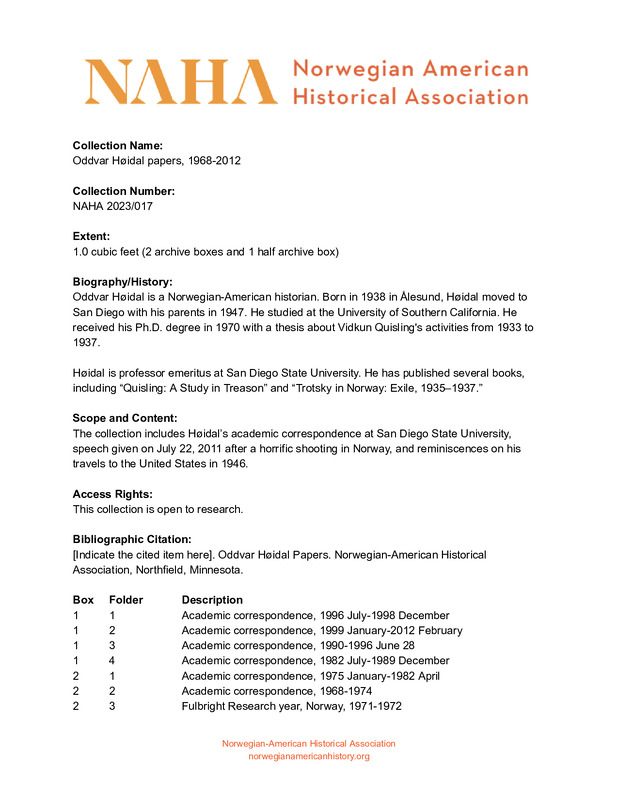
Oddvar Høidal papers, 1968-2012
Biography/History:
Oddvar Høidal is a Norwegian-American historian. Born in 1938 in Ålesund, Høidal moved to San Diego with his parents in 1947. He studied at the University of Southern California. He received his Ph.D. degree in 1970 with a thesis about Vidkun Quisling's activities from 1933 to 1937.Høidal is professor emeritus at San Diego State University. He has published several books, including “Quisling: A Study in Treason” and “Trotsky in Norway: Exile, 1935–1937.”
Scope and Content:
The collection includes Høidal’s academic correspondence at San Diego State University, speech given on July 22, 2011 after a horrific shooting in Norway, and reminiscences on his travels to the United States in 1946. -
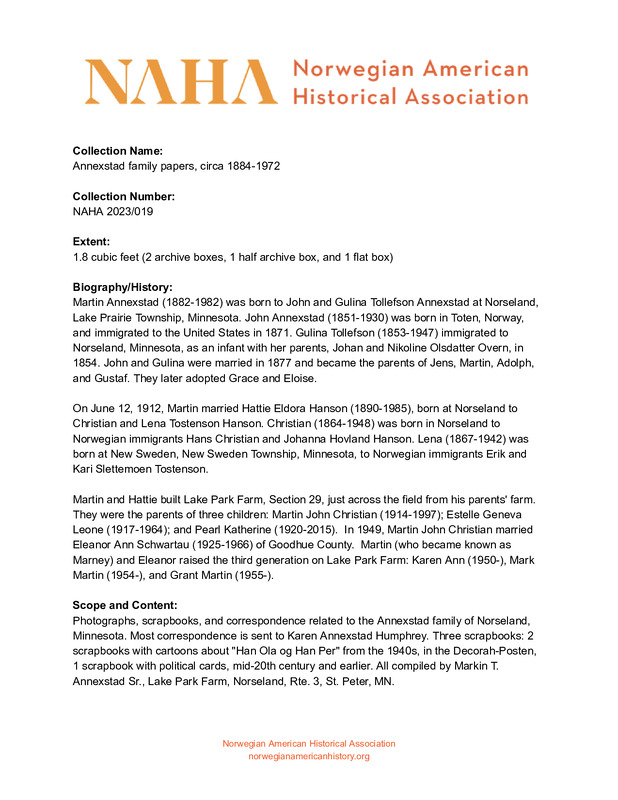
Annexstad family papers, circa 1884-1972
Biography/History:
Martin Annexstad (1882-1982) was born to John and Gulina Tollefson Annexstad at Norseland, Lake Prairie Township, Minnesota. John Annexstad (1851-1930) was born in Toten, Norway, and immigrated to the United States in 1871. Gulina Tollefson (1853-1947) immigrated to Norseland, Minnesota, as an infant with her parents, Johan and Nikoline Olsdatter Overn, in 1854. John and Gulina were married in 1877 and became the parents of Jens, Martin, Adolph, and Gustaf. They later adopted Grace and Eloise.On June 12, 1912, Martin married Hattie Eldora Hanson (1890-1985), born at Norseland to Christian and Lena Tostenson Hanson. Christian (1864-1948) was born in Norseland to Norwegian immigrants Hans Christian and Johanna Hovland Hanson. Lena (1867-1942) was born at New Sweden, New Sweden Township, Minnesota, to Norwegian immigrants Erik and Kari Slettemoen Tostenson.
Martin and Hattie built Lake Park Farm, Section 29, just across the field from his parents' farm. They were the parents of three children: Martin John Christian (1914-1997); Estelle Geneva Leone (1917-1964); and Pearl Katherine (1920-2015). In 1949, Martin John Christian married Eleanor Ann Schwartau (1925-1966) of Goodhue County. Martin (who became known as Marney) and Eleanor raised the third generation on Lake Park Farm: Karen Ann (1950-), Mark Martin (1954-), and Grant Martin (1955-).
Scope and Content:
Photographs, scrapbooks, and correspondence related to the Annexstad family of Norseland, Minnesota. Most correspondence is sent to Karen Annexstad Humphrey. Three scrapbooks: 2 scrapbooks with cartoons about "Han Ola og Han Per" from the 1940s, in the Decorah-Posten, 1 scrapbook with political cards, mid-20th century and earlier. All compiled by Markin T. Annexstad Sr., Lake Park Farm, Norseland, Rte. 3, St. Peter, MN. -
Gretchen U. Beito papers, 1955-2021
Biography/History:
Gretchen Beito is the author of "Coya Come Home," "Tales of the Secret Earth River," "From Agassiz to Zeh," and five Scandinavian doll books.. She earned a Master's degree in history at University of North Dakota.Scope and Content:
Publications written by Gretchen Beito, along with research notes, clippings, and articles on Coya Knutson. -
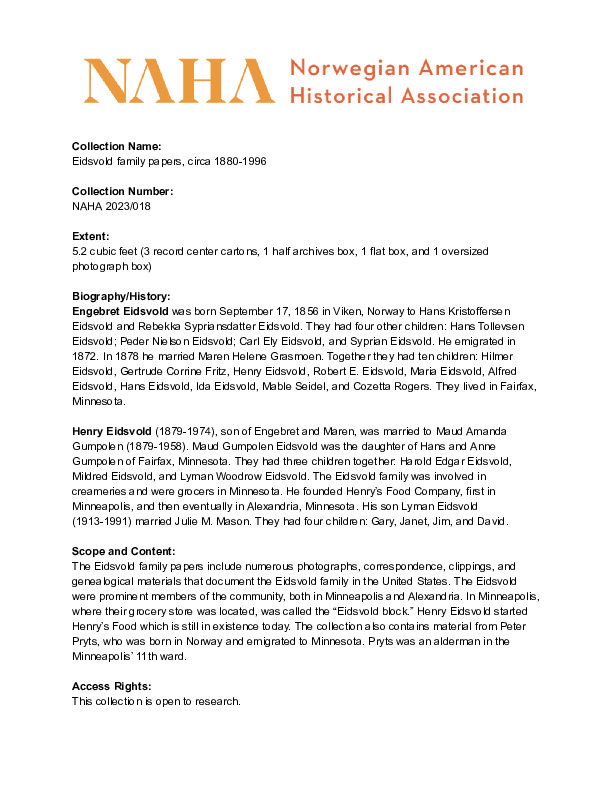
Eidsvold family papers, circa 1880-1996
Biography/History:
Engebret Eidsvold was born September 17, 1856 in Viken, Norway to Hans Kristoffersen Eidsvold and Rebekka Sypriansdatter Eidsvold. They had four other children: Hans Tollevsen Eidsvold; Peder Nielson Eidsvold; Carl Ely Eidsvold, and Syprian Eidsvold. He emigrated in 1872. In 1878 he married Maren Helene Grasmoen. Together they had ten children: Hilmer Eidsvold, Gertrude Corrine Fritz, Henry Eidsvold, Robert E. Eidsvold, Maria Eidsvold, Alfred Eidsvold, Hans Eidsvold, Ida Eidsvold, Mable Seidel, and Cozetta Rogers. They lived in Fairfax, Minnesota.Henry Eidsvold (1879-1974), son of Engebret and Maren, was married to Maud Amanda Gumpolen (1879-1958). Maud Gumpolen Eidsvold was the daughter of Hans and Anne Gumpolen of Fairfax, Minnesota. They had three children together: Harold Edgar Eidsvold, Mildred Eidsvold, and Lyman Woodrow Eidsvold. The Eidsvold family was involved in creameries and were grocers in Minnesota. He founded Henry’s Food Company, first in Minneapolis, and then eventually in Alexandria, Minnesota. His son Lyman Eidsvold (1913-1991) married Julie M. Mason. They had four children: Gary, Janet, Jim, and David.
Scope and Content:
The Eidsvold family papers include numerous photographs, correspondence, clippings, and genealogical materials that document the Eidsvold family in the United States. The Eidsvold were prominent members of the community, both in Minneapolis and Alexandria. In Minneapolis, where their grocery store was located, was called the “Eidsvold block.” Henry Eidsvold started Henry’s Food which is still in existence today. The collection also contains material from Peter Pryts, who was born in Norway and emigrated to Minnesota. Pryts was an alderman in the Minneapolis’ 11th ward.
-
The Great Storm: Minnesota's Victims in the Blizzard of January 7, 1873
On January 7-9, 1873, Minnesota residents experienced a violent blizzard when dozens of people died primarily on the State’s flat, tree-less prairies. Minnesota native, Carolyn Mankell Sowinski takes the reader back 150 years and tells the stories of these victims using primary documents and secondary sources in her latest book, The Great Storm: Minnesota’s Victims in the Blizzard of January 7, 1873. She has identified 84 people from 31 western and southern counties who died in this storm: men and women, children and babies, Civil War veterans and recent immigrants, homesteaders and villagers, state residents and visitors. Friends died together, neighbors died together, family members died together. Many died alone--suffering for one, two, or all three days. Sowinski also tells the stories of 25 people who suffered amputations and other life-changing injuries. The biography of each victim provides genealogical information, immigration story, place of residence, journey in the storm, and burial location. Each biography also includes a section titled “Adventures in Research” where Sowinski provides other information about the victim, local history, or her research process in identifying these victims. The reader will also learn about the State’s Native American population who were removed from their historic lands, making room for the homesteaders.
Carolyn Sowinski is a graduate of St. Olaf College (Class of 1980). -
Mindekirken: Against The Current, 2022
"Mindekirken: Against The Current" tells the story of the founding of Mindekirken in 1922. It describes the context in which it was born and examines how young people in the Phillips neighborhood worked to found an exclusively Norwegian speaking congregation, going against the currents of the day. It tells of the building of the church edifice from 1926-1930, led by Pastor Christian Munson, and finished just as the Great Depression struck. The group was left with an enormous debt. When Pastor Elias Rasmussen came to serve the congregation, it had a debt of almost $250,000 and not quite $50 in the bank. The book tells the story of how the congregation emerged from the Depression, lived through World War II, and the Fifties, and the work of their diligent pastors, Mons Wee, Anders Hulteng, Christian Munson, and Elias Rasmussen.