
Welcome to the NAHA Collections Catalog!
Use our online catalog to explore our archival and manuscript collections. Some finding aids are currently offline, but we’re happy to help – just reach out to the NAHA archivist with any questions. Looking for digitized materials? Click here to browse thousands of items available online!
Browse Items (3064 total)
-
Gerhard Rasmussen papers, 1876-1946
Biography/History:
Rev. Gerhard Rasmussen was a Lutheran clergyman, born January 26th, 1857 in Lisbon, Illinois. He became one of the many clergymen to come to Minnesota to preach to Scandinavian immigrants in the surrounding regions.Scope and Content:
Articles, autograph books, clippings, correspondence, diaries, notebooks, reports, and sermons. Among his papers are materials on the Lutheran Deaconess Home and Hospital in Chicago, Augsburg Seminary, St. Olaf College, the use of the English language in the church (1893), Lisbon, Illinois, cultural conditions, the merger movement among Norwegian Lutherans, and sketches of his father, P. A. Rasmussen. Among his correspondents are Nils C. Brun, Markus O. Bøckman, Theodor H. Dahl, Peder Dreyer, Thore Eggen, Peder J. Eikeland, Nils J. Ellestad, Severin Gunderson, Bjørn Holland (his mother's brother), Hans C. Holm, Even J. Homme, Mikel C. Holseth, John N. Kildahl, Laur. Larsen, Gerhard Lenske, Lars Lund, W. A. Passavant, L. H. Schuh, Hans G. Stub, Peder Tangjerd, Martin E. Waldeland, and Carl M. Weswig. Most of the letters by Rasmussen are to his parents and to Gjermund Hoyme. -
Red Wing Seminary papers, 1887-1933
Biography/History:
Red Wing Seminary started as the educational center for the Hauge Synod, and was in operation from 1879 to 1932. By 1917, with the merger of the Hauge Synod into the Norwegian Lutheran Church of America, a new seminary was formed called Luther Theological Seminary in St. Paul, Minnesota. After that merger, the school continued on as an academy and junior college of the Norwegian Lutheran Church of America. However, in 1932 those programs were merged into St. Olaf College.With the creation of the Hauges Synod in 1876, there was a calling to provide better education for training men for the ministry. The first attempt for a school was in 1854 in Lisbon, Illinois. A second attempt in 1865 at Koshkonong, but not until land was purchased in Red Wing, Minnesota, in 1867, was there a start to solidifying a center for education. However, the synod abandoned the project in 1877 – nearly a decade later.
H.M. Sande, Rev. Østen Hanson, and A. Ellingson purchased an abandoned school property in Red Wing. The deal was later approved by the Synod and the land previously bought was traded in on this property. The next challenge, after purchasing the property, was to find teachers for the seminary. At a Synod meeting in 1879, they extended a call to Rev. A. Weenaas of Norway to become the new president and theological professor. However, he declined.
Their luck changed when they decided to extend a call to Rev. I. Eistensen to be a temporary resident and theological professor. He accepted and opened the seminary on September 17, 1879. The seminary also had Prof. G.O. Brohough to teach preparatory classes. However, when Rev. Eistensens' year as temporary president was up, he declined to renew his position. The Synod sent a delegation to Norway to secure a professor and pastor for the school.
Professor Weenas was selected, but he could not come for a year. J. Kyllingstad, who just returned from mission work in Africa, was the temporary president and instructor in religion. Professor Weenas arrived in the summer of 1882, with the school opening up that fall. The first students of the theological department included Iver Hatlestad, T.J. Skjei, G.C. Gjerstad, C.C. Holter, L.L. Nervig, J.B.A. Dahle, A. Wold, O.O. Bergh. M.G. Hanson, and P.C. Rømo.
Scope and Content:
Correspondence, records, catalogs, photographs, and histories of a Lutheran Seminary founded in 1879, as both an academy and a divinity school. The correspondence deals with the problems of the post-merger period, recruitment of students, employment and salaries of teachers, and the organization of new departments. -
Ditlef G. Ristad papers, 1880-1938
Biography/History:
Ditlef G. Ristad was born in Norway in 1863 and came to the United States in 1887. He was naturalized in 1917. He graduated from Luther Theological Seminary in 1892 and studied at the University of Chicago, and did further study and travel in Europe. He was a poet, educator, lecturer, and Lutheran clergyman. He was a minister at Edgerton and Manitowoc, Wisconsin; president of three church schools; editor of "Wisconsin Tobacco Reporter"; first president of NAHA; president of the Trønderlag; and president of the Eastern District of his church (1936-1937).Scope and Content:
Correspondence; manuscripts of articles, lectures, poems, and sermons by Ristad; clippings of articles by and about him and subjects in which he was interested; and records of organizations he supported. Papers deal with such subjects as church union; Grundtvigianism; church school problems; organization and finances of the church; the Norwegian Museum at Decorah, Iowa; the collecting, research, publication, and financial program of NAHA; the Norwegian-American exhibit at the Century of Progress, Chicago; restoration of the Trondheim Cathedral; and the preservation of Norwegian culture in America. Correspondents include J. A. Aasgaard, Waldemar Ager, T. C. Blegen, L. W. Boe, Arne Fjellbu, L. M. Gimmestad, Knut Gjerset, Carl G. O. Hansen, Einar Haugen, Jacob Hodnefield, Hjalmer R. Holand, M. A. Holvik, U. V. Koren, Laur. Larsen, R. Malmin, O. M. Norlie, Jon Norstog, Torkel Oftelie, Julius E. Olson, Birger Osland, E. J. Oyen, Kristian Prestgard, C. K. Preus, Ove J. H. Preus, Carlton C. Qualey, O. E. Rølvaag, A. N. Rygg, Peder Tangjerd, I. B. Torrison, and Johs. B. Wist. -
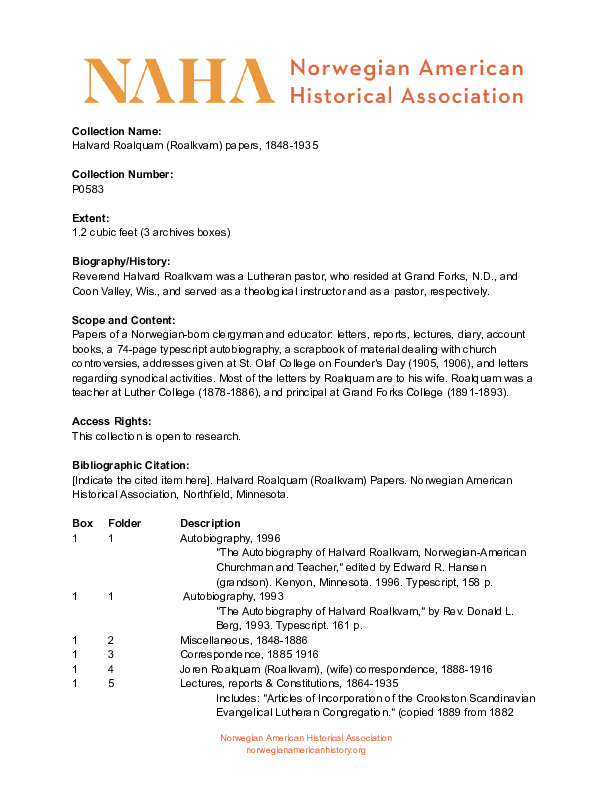
Halvard Roalquam (Roalkvam) papers, 1848-1935
Biography/History:
Reverend Halvard Roalkvam was a Lutheran pastor, who resided at Grand Forks, N.D., and Coon Valley, Wis., and served as a theological instructor and as a pastor, respectively.Scope and Content:
Papers of a Norwegian-born clergyman and educator: letters, reports, lectures, diary, account books, a 74-page typescript autobiography, a scrapbook of material dealing with church controversies, addresses given at St. Olaf College on Founder's Day (1905, 1906), and letters regarding synodical activities. Most of the letters by Roalquam are to his wife. Roalquam was a teacher at Luther College (1878-1886), and principal at Grand Forks College (1891-1893). -

Nils N. Rønning papers, 1903-1955
Letters, clippings, articles, pamphlets, reviews, correspondence, and notes of a Norwegian-born journalist and author. Includes reviews of Rønning's books, notes on Hans Nielsen Hauge and Elling Eielsen, and historical sketches of the Homme Home for Boys, Wittenberg, Wisconsin. The reports and articles include materials on fiddlers, sketches of Torkel Oftelie and Th. N. Mohn, and a statement of the value of bilingualism to the Norwegian American by Anna Thykesen. Rønning was editor of "Ungdommens Ven," "Familiens Magasin," "The Friend," and "Telesoga." Correspondents include Richard Beck, Theodore C. Blegen, J. A. Holvik, Hanna Astrup Larsen, K. O. Lundeberg, O. M. Norlie, D. G. Ristad, and Mrs. O. E. Rolvaag. -

Ola Johann Saervold papers, 1840-1941
History/Biography:
Ola Johann Saervold was a sailor on the Great Lakes (1886-1889); a student at Luther College (1889-1895); a correspondent for "Inter-Ocean" (Chicago) (1895-1898); a lecturer and newspaper correspondent who described his travels in Norway (1899-1910); a farmer on the ancestral farm in Strandvik, Midthordland, Norway, which he equipped and operated according to American standards (1910-1918); a traveler and correspondent for "Skandinaven" (1921-1925). He was the author of four books: "Erling" (1898), "Det store stevne i Camrose, Canada" (1926), "Reisebreve," 3 volumes (1926), and "The Discovery of America" (1931).
Abstract:
Biographical miscellany, correspondence, articles, clippings, account books of a Norwegian-born, American-educated, Minneapolis resident, world traveler and lecturer, journalist and linguist, farmer and sailor. His papers contain transcripts of legal documents dealing with the history of the Saervold farm; his Luther College report cards; a recipe book (manuscript) from the Lutheran Ladies' Seminary (Red Wing, Minnesota); a domestic science course (1908-1909); and manuscripts titled "Prestehjemmenes plads i vort folkeliv," "Kirken og det norske sprog i Amerika," and "What Is the Matter with Minnesota and Why" (a study of taxation). Correspondents include B. E. Bergeson, L. W. Boe, Juul Dieserud, Einar Hoidale, Peter Norbeck, and Henrik Shipstead.
-

Friedrich August Schmidt papers, 1848-1926
History/Biography:
Reverend Fredrich August Schmidt was born on January 3, 1837 in Thüringen, Germany. He graduated in 1853 from Concordia College. Four years later he finished seminary work at Concordia and became minister to a German congregation in Eden, NJ. In 1861, Schmidt became associated with the Norwegian church when he started teaching at Halfway Creek, near La Crosse. The next year, the school renamed itself Luther College and moved to Decorah, Iowa. Schmidt was an instructor at Luther College until 1872. After his stint at Luther College, he took a professorship in Concordia Seminary in St. Louis, which was then supported by the Norwegian synod. Rev. Schmidt headed the faction that left the synod in 1886 and organized "The anti-Missourian Brotherhood." In that year he also became theological instructor at St. Olaf's college, Northfield, Minnesota, for this faction.Scope and Content:
Correspondence, clippings, and articles, written in English, German, Latin, and Norwegian. Among the subjects discussed are doctrines concerning absolution, assurance, conversion, and election; position and participation of the laity in doctrinal disputes and clerical leadership in such controversies; Augsburg College and St. Olaf College; and the union movement that led to the 1917 merger. There are only two letters by Schmidt. Among the correspondents are M. O. Bøckman, C. L. Clausen (February 2, 1863), N. J. Ellestad, O. J. Hatlestad, P. P. Iverslie (December 27, 1883), Kristofer Janson (March 31, 1891), J. N. Kildahl, U. V. Koren, Laur. Larsen, A. Mikkelsen, Th. N. Mohn, B. J. Muus, J. A. Ottesen, H. A. Preus, P. A. Rasmussen, Halvard Roalquam, and H. A. Stub. -

A.O. Serum papers, 1871-1927
Correspondence, reports, speeches, articles, clippings, and account books of a Norwegian-born farmer at Halstad, Minnesota. The papers include school district reports; articles and letters treating the early days in the Red River Valley; correspondence with Fuller and Johnson, farm machinery company, Madison, Wisconsin; and personnel at Augsburg and Augustana (Marshall, Wisconsin) seminaries. The clippings include items on synod controversies and letters from World War I servicemen. Serum held state and church offices, spoke on crop production, suffrage, monopoly, cooperatives, and local history, was the first teacher in his district, the first president of the Selbulag, and the author of "Nybyggerliv i Red Riverdalen" in "Selbygbogen." -

Carl K. Solberg papers, 1886-1951
Correspondence, articles, diaries (10 boxes), poems, pamphlets, scrapbooks, photograph albums, and notebooks of a Lutheran clergyman, poet, author, and lecturer. The diaries cover most of the period between 1892 and 1945, including Solberg's student career at St. Olaf College and United Lutheran Church Seminary. Among the articles are such titles as "The Restoration of Israel," "Do We Need a Chair in English Bible in Our Seminary?" "Spiritualism," "Our Greatest Enemy" (temperance), and "A Scene from College Life" (St. Olaf College). Solberg was parish minister in South Dakota, Chicago, and Minneapolis. Among his books are "A Brief History of the Zion Society for Israel" (1928), "Scriptural Evangelism" (1935), "In Quiet Moments", and "Sacred Verse" (1940).
-
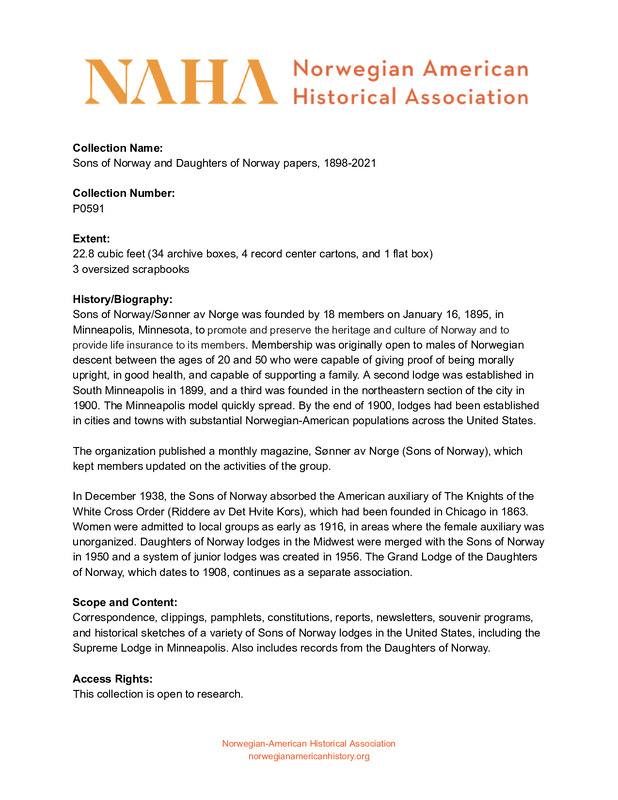
Sons of Norway and Daughters of Norway papers, 1898-2021
History/Biography:
Sons of Norway/Sønner av Norge was founded by 18 members on January 16, 1895, in Minneapolis, Minnesota to promote and preserve the heritage and culture of Norway and to provide life insurance to its members. Membership was originally open to males of Norwegian descent between the ages of 20 and 50 who were capable of giving proof of being morally upright, in good health, and capable of supporting a family. A second lodge was established in South Minneapolis in 1899 and a third was founded in the northeastern section of the city in 1900. The Minneapolis model quickly spread. By the end of 1900, lodges had been established in cities and towns with substantial Norwegian-American populations across the United States.
The organization published a monthly magazine, Sønner av Norge (Sons of Norway), which kept members updated on activities of the group.
In December 1938, the Sons of Norway absorbed the American auxiliary of The Knights of the White Cross Order (Riddere av Det Hvite Kors) which had been founded in Chicago in 1863. Women were admitted to local groups as early as 1916, in areas where the female auxiliary was unorganized. Daughters of Norway lodges in the Midwest were merged with the Sons of Norway in 1950 and a system of junior lodges was created in 1956. The Grand Lodge of the Daughters of Norway, which dates to 1908, continues as a separate association.